Saturday, February 15, 2014

Ready for Your Big Break? Coincidence in Your Career

You never know what might happen one plain old day at work that will change you life.  Lay a good foundation of work ethics and principals and when the unexpected happens, you never know where it will take you.

My hairdresser was working early this year, a normal day in a normal shopping plaza when suddenly 3 big guys came into the salon and asked if there was a room where a 'high-profile' client could get a hair cut.  After some discussion, they agreed on a room in the back and said that they would return in a hour with 'the client.' Some time later they return with the rest of their security team and the Prime Minister of Canada.  He wanted a trim.  My hairdresser was happy to oblige.  I think this might have something to do with why she is charging more now  :-)  You can make it big in the hair industry based on whose hair you've styled, from what I understand.

Another story...
Almost 10 years ago now, I was riding public transit to work and saw an advert for a software development course at the local technical college.  On a whim, I thought I'd email them and see if they needed any instructors.  That email got forwarded to the coordinator for the department who ended up being a teacher of mine from the past.  He offered me an opportunity on the spot, and I've been teaching here ever since and loving it!


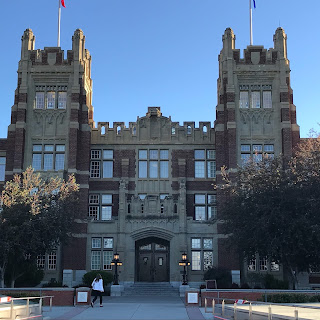
Southern Alberta Institute of Technology
Heritage Hall

Wednesday, February 12, 2014

An Iterative Career Path - Finding the Right Education and Job Fit for Graduates and Young Adults

Waterfall

20 to 30 years ago, software development was generally executed using a development practice called 'Waterfall.'  It got this name because it was very sequential and hardly ever went back to revisit previous decisions that had been made.  Essentially it worked like this - like water in a waterfall, once you started the various phases of the project, you didn't hesitate, look back, or stop until everything was done.  Then the product was passed onto the next phase/department for their work.

Projects build using 'Waterfall' were found to be expensive, risky, and inefficient.  Some specific issues with this development approach were:
- You don't realize any value until the end of the project
- You leave you QA (quality assurance or testing) until the end
- Requirements for the project may have changed during your build (some projects take several years)
- You are singularly focused on your goal - the completion of your plan
- You make one 'all or nothing' development gamble without considering alternative options

I think many young people today default to a 'Waterfall' strategy when it comes to their education and career.  Some people can focus on becoming a doctor or astrophysicist and the have the resources, the stamina, and the smarts to get the education required for it.  However, this approach assumes that you're guaranteed a job that meets all your expectations when you finish you education.  But how often does that happen?  Hardly ever.

Young people today are practically gambling their time and resources on an education that was based on a guess or a whim.  But the decision wasn't followed with a thorough investigation or analysis.

A Waterfall Solution

The software development community solved their problem by changing their development processes from 'Waterfall' to 'Iterative'.  An iterative solution basically means having smaller plans with shorter time frames, execute them, and then test to see if your happy with the results - and do this multiple times. Each planning/execution/testing/review cycle is called an iteration.  To sum it up - How do you eat an elephant?  One bite at a time.

Using the 'Iterative' approach, young people could evaluate and test their assumptions to see where they are at in their education and career development on a yearly basis.  Clayton Christensen in How Will You Measure Your Life suggests young people consider this type of solution for the 'Waterfall' problem (see the chapter: The Balance of Calculation and Serendipity).  Take a step and then evaluate.  Even an aspiring doctor or astronaut with a multi-year plan can use this approach to continually evaluate and confirm that they are on the right track.

Looking back at the issues with the Waterfall approach, let's see how an Iterative approach could possibly help:

Waterfall Issue - You don't realize any value until the end of the project
Iterative Resolution - Try to find some value early in your education and career choice - in other words, go on an early internship.   A year or two into school, get a job in your chosen field and see what its like.  Or alternatively, get some experience as a volunteer in what you'd like to do.  There more about finding value that just remuneration.  Teach what you learned to someone else.  Practically give what you've learned away with a humanitarian outreach in another country.  There's always options if you are motivated enough to look for them.

Waterfall Issue - You leave your QA (quality assurance or testing) until the end
Iterative Resolution - Evaluate your experiences in trying to realize some early value on a regular basis (annually?).  Did you enjoy the work and what you learned?  Were you pleasantly surprised by anything?  Are you making any assumptions about your career or about yourself in your current plan?  What are they?  (For example: Can you work shift work for the rest of your life? or Do you want to work outside in the elements for the rest of your life?)  Ask people questions while you're working as an intern!  Question like..  Why did you choose this career?  Do you still enjoy it?  Why or why not?  What do you like best about this job?  What do you dislike the most? And finally, consider and confirm if your education and career choice is still valid or if you need to tweak things or try something else.  Has something different piqued your interest?

Waterfall Issue - Requirements for the project may have changed during your build.
Iterative Resolution - This involves more scrutiny of assumptions you may have made - perhaps they weren't even assumptions at the time.  For example, what if NASA changed requirements for all astronauts to have 20/40 vision while you were getting your BSc and you've only got 20/20 vision? Or, what if geologists were in high demand when you went into school and the price of oil was $160 a barrel, but now they are all getting laid off because there's an oil glut because of fracking.  Or, what if you started a computer science degree focusing on the Visual Basic language, and now the industry has evolved to using Java and C# and you won't be able to get a job with only VB experience?  You need to continually assess the path you are on to see if the original plan (or requirements) you had are still true. 

Waterfall Issue - You are singularly focused on your goal - the completion of your plan
Iterative Resolution - Take a break from 'the plan' and look at where you are headed.  Perhaps there are changes that are happening within yourself the might give you pause.  Will your plan need to change because your health or what you believe has changed?  Are there other factors that need consideration - are relationships getting sidelined because they are in the way of your goal.  What is more important?  Consider trying two different options in parallel for a while. Change you plan if you have to.  Be flexible. 

Waterfall Issue - You make one 'all or nothing' development gamble without considering alternative options
Iterative Resolution - Don't gamble all your money, time, and resources into one plan.  Experiment.  Take a one year, hands on course in something practical that you like.  Work in that field for a bit (a year or so) and evaluate.  Is this something you could continue doing?  Is there something out there that is more interesting or that you are more passionate about?  If so, take a course in that.  Poke, poke.  Test the waters.  Or alternatively, head down the road of that one big plan, but stop along the way and verify that your still on the right road for you.  Has something changed in your understanding of this career that concerns you?  Always, continually evaluate and verify, tweak and experiment. 
Monday, February 10, 2014

What Are You Agreeing to, Grads?

Once in a while something will happen that will get me frustrated a bit.  This past week I had two situations where I had volunteered to do something, and in the end I was essentially told that my help wasn't required.  In both instances, I had spent time preparing for my involvement (either preparing to speak or perform), so it was a bit of a let down to be effectively 'turned down.'  When situations like this happen to me, I find it easy to get stuck in a spiral of 'agreeing' to negative thoughts, like:
- I'm a nobody, I don't count
- I'm being marginalized and pushed to the side
- Maybe I don't matter...

What I do with these thoughts makes all the difference.  If I choose to 'agree' with them, throw a little pity party and think 'Yeah, that must be it.  I don't really make a difference, I don't count',  it leads no where good or productive.  A dead end.

An agreement is defined as 'harmony or accordance in opinion or feeling.'  I might have felt that way about my situation, but it is a bad thing for me to agree in my mind to the statement that 'I am a nobody and I don't count.'  What I think and what I say (even just to myself) has more influence than we can imagine.  Please be very wary and careful about the thoughts that you decide to 'agree' with.

Monday, February 3, 2014

A Different Post-Secondary Education - Learning About Life From Experience

Perhaps in the future, when I finally finish writing my book, it sells big, and I've made a bit of a name for myself, I'll start a school.  It will be a school targeted at young people just out of high school or in the middle of college.  It will be about getting a 'different' education.  Learning to learn for yourself.  Getting and gaining experiences you wouldn't have otherwise considered.  Expanding your horizons to get a better idea of who you truly are and what your potential is.

I don't have it all figured out yet.  I have done curriculums in the past for post-secondary courses, so at least that isn't new to me.  This would be quite a bit different, though.  In this course, you would:

  • Be Challenged to Confront Your Fear - You would need to do an activity to confront a fear you have.  For example:
    • Bungy cord jumping (fear of heights)
    • Public speaking (fear of public speaking)
    • Travel (fear of the unknown)
    • Write 3 letters to famous people you've always wanted to talk to but thought you couldn't  and see if you can get them to respond (fear of intimidation)
    • Read and write a book report on Feel the Fear.. and Do It Anyway by Susan Jeffers PhD.
  • Learn to Manage Finances and Resources 
    • Play Monopoly with real money!  Discover how much chance/providence has an impact on your financial planning.  Learn to manage your money.
    • Play the 'Trade Up' game.  Start with a paper clip.  In a week see what you can trade that up to using your wits, connections, and integrity.
    • Read and write a book report on The Wealthy Barber by David Chilton
    • Read and write a book report on Rich Dad Poor Dad by Robert Kiyosaki
  • Deal with Change 
    • Go on outing with no food or money and asked to accomplish a task that requires both.
    •  Given a sudden weekend trip with little time to pack or prepare for it.  Perhaps a survival camping trip?
    • Thrown into a real world job situation - high stress, people depending on you with expectations changing all the time.  (Waitress/waiter at a restaurant, for example)  How do you adapt?  What did you like and or dislike about it?
    • Read and write a book report on Who Moved My Cheese? by Spencer Johnson
  • Discover Your World.  Everything is a learning experience.  
    • Organize your own trip to India - required reading on the trip? The book Freedom at Midnight, or
    • Organize a trip to Europe.  Required reading on that trip?  The book The Big Short, or
    • Organize your own trip to the Middle East.  Required reading on that trip?  The Pulitzer Prize winning book 'The Prize'.
  • Consider a Real Career Fit
    • Read and write a book report on What Should I Do With My Life by Po Bronson
    • Read and write a book report on What Colour is Your Parachute by Richard Bolles
    • Organize a working interview with someone in a career you think you'd fit into.
    • Organize a working interview with someone working at your dream job
    • Answer questions like: Do you know what you'd like to do for a career?  Why or why not?  What do you think you would be good at?  Do renumeration or outside pressure influence your current career decisions?
  • Find and Discover Who You Are
    • Start a journal, answering questions like:
      • Do I want to get married?  When?  Why not sooner or later?
      • Do I want to have kids?  When?  Why?
      • What is my current career plan?  What careers seem to interest me?  Why?
      • What would be a dream job of mine?  Why would it be my dream job?
      • What are my education aspirations?  Who was my favorite teacher growing up?  Why?  What was my favorite subject growing up?  Why?
      • Would I like to travel in the future?  Where?  Why there?  How long would I go for?  What would I do while I'm there?
    • Read and do the questionnaire for The Strength Finder by Tim Rath.  Following that answer questions about how you felt about the results of the questionnaire.  Would you consider those your strengths?  Why or why not?
    • Read and write a report on the book How Will You Measure Your Life by Clayton Christensen
    • Read the book Fierce Conversations by Susan Scott and do the exercises she gives throughout the book.

Saturday, February 1, 2014

How Will You Measure Your Life by Clayton Christensen - Book Review and Thoughts

How Will You Measure Your Life is a great read for young adults and recent grads.  Drawing from his wealth of experience in a variety of fields, Mr. Christensen effectively uses real life business dilemmas, personal anecdotes, and history to challenge the reader in thinking about their future career, family life, and values.

This New York Times Bestseller is almost 220 pages and offers some innovative thoughts on how to make career choices, how to engineer your career for success, and how to raise a family.  The book is in 3 parts:  Finding Happiness in Your Career, Finding Happiness in Your Relationships, and Staying Out of Jail (this one probably influenced by the fact that one of Clayton's classmates was jailed for his role in the Enron scandal.

I'd highly recommend this book and give it a 4.5 out of 5.

Monday, November 11, 2013

Jobs after Graduation - Ignore the fear!

There is no lack of media proclaiming how difficult it is for todays young adults to find work and get a permanent place in the workforce.  Be careful!  These are opinions - don't let them become a part of your belief system.  All the negativity can be detrimental to your job and career search.  There's nothing wrong with 'considering' the information.  But don't always believe what you read.  There's always another point of view.

 In this article, Millennial's Endless Youth, the author talks about how much harder it is now for young adults to find work, citing various reasons.  He quotes a study that says "the economy determines what the possibilities are for young people".  If you believe that, you are in trouble.  Essentially he's saying you can blame the economy for all your problems!  You can sit on your parent's couch and feel good about it.  I wouldn't subscribe to that.
There are a host of other things like the people you know, your attitude, how motivated you are, your capacity to learn, your capacity to do physical work, your geographic location, etc. that also majorly influence your possibilities for work.

In this depressing piece - Student Dept, Dismal Job Prospects Threaten Canada's Economy - the author
discusses how student debt and poor jobs prospects have an impact on the students and the Canadian economy as a whole.  That's a real downer when you factor in the the article in the previous paragraph.  Don't listen to all this fear!  There is so much potential in you to learn and do great things.  You just have to find the right door.

Perhaps part of that 'door' is alluded to in this article - The Real Reason New College Grads Can't Get Hired.  The author suggests that a lack of 'soft skills' is a big part of the problem.  Young Adults "don't know what they don't know."  Of course, this is true for anybody.  But its amazing how fast you can learn and get good at a job when you are motivated - whatever that motivation is.   I know that young people can be amazingly fast learners and have the flexibility to change and meet the challenges presented to them - if they aren't demotivated and demoralized by what they hear, read, see. You can find the right door.  Sometimes it takes a bit of experimenting, patience, and determination, but you can do it.

Where's the Crime in Wasting Time is a better article.  It starts with the same abysmal statistics, but then looks towards good solutions.  I love this line: "Four years is an eon when you are young: something well meaning parents and fear-mongering journalists should consider before pushing rigid career plans on high school students."  Preach it, sista!  The two stories she shares in the article are great - about how she found her career in writing and how her friend ended up being a teacher.  Don't give into the fear you read and hear about.  Finding your career fit takes time.  You may not know what you are going to do in your last year of university.  Take a break.  Take a trip.  Discover yourself and what you like.  Then you will find a career you'll enjoy, be motivated in, and as a result, successful at.


Sunday, October 6, 2013

Travel After School - My Second Overseas Trip (Europe)

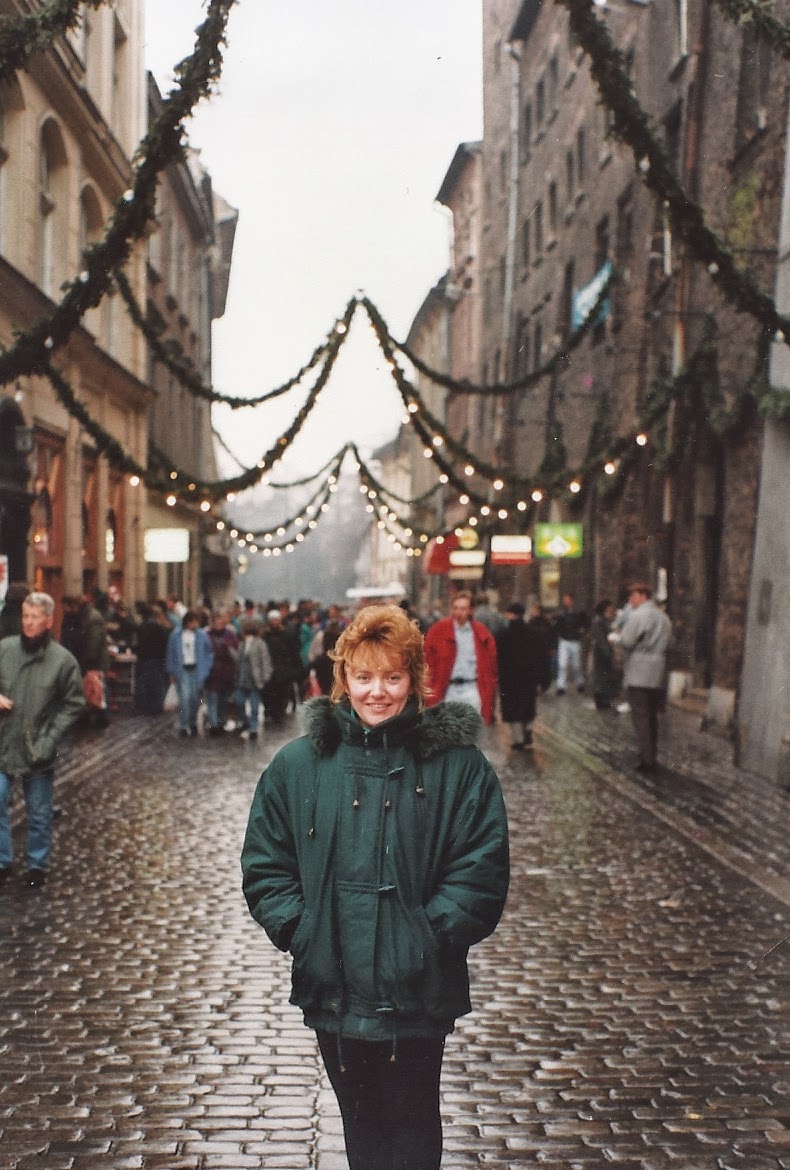
Ewa, in Krakow, Poland.
December 29, 1993
My second overseas trip was to Europe.  Many of my friends had already been to or lived in Europe in some form or fashion and I had heard all of their stories and was itching to get there myself.  I had several reasons for going:
  1. My main motivation for the trip was to go to Poland and meet the family of my girl friend, Ewa.  I needed to know if I could live in Poland as I was considering marrying her.  So going there and getting exposure to the culture and language was pretty important to me.
  2. I wanted to spend some time with a great friend of mine, Kevin,  in Holland.  I had met him in Texas, and he had been working and living in Holland for close to a year and I wanted to catch up with him.
  3. I had some graphic arts film negatives to deliver to an organization in Austria.  They were translating some Christian discipleship tracts into various eastern european languages and the art work for these tracts was on the film I was delivering.
  4. I wanted to accompany a professor of mine and visit our mutual friend Janis, in his home country, Latvia.  I had worked and gone to school with him in Texas for a while and I wanted to see him in his home country.
Kevin in Pernis walking on a dyke
with a canal in the background
My trip lasted from the middle of December 1993 to April 1994.  My plan for this trip wasn't as rigid as my India/Pakistan trip.  There were certain places I had to be a certain times, but I also had several spaces of a week or two where nothing specific was planned.  This helped me be flexible with situations like passport replacements (see below) and other travel hiccups.  However, knowing where you are going to sleep is pretty important.  I had a pretty good idea where I would be spending my evenings for most of the trip.  Check my travel resources page for ideas on how to travel and getting a place to stay (and potentially room and board covered).
I flew into London and took a train from there to Rotterdam.  There was no tunnel under the English Channel back then so I caught a ferry across the channel.  Arriving in Holland, Kevin picked me up with a friend of his in a Peugeot.  I stayed with Kevin in Pernis, a small town on the outskirts of Rotterdam.  I was there while I recovered from jet lag, then take a train from Amsterdam to Poland.  I would be returning to Holland to visit Kevin for a longer period at the end of my trip in March.

While there in December, I had a great time catching up with him and meeting all of his friends.  We helped some of them decorate for Christmas, and it was interesting to see the similarities and differences in their holiday tradition.  I really enjoyed walking through the community and seeing how people lived there.  Some houses are built right up against the sidewalk, and you could look right in the windows.  Bike paths were everywhere, as were waffle stands (a great Dutch snack).      

Some old Polish coins
I said goodbye to Kevin in Amsterdam and caught various trains to Berlin, into Poznan, Poland, on to Wroclaw, and finally to Strzelin - Ewa's home town.  Getting tickets for each transfer got progressively more challenging as less people spoke English and I had to change money every time.  I just about missed my transfer in Poznan as I wasn't clear on when the train was leaving and which platform it was leaving from.  I didn't really have much of a chance to get settled there because two days later all of us headed further south-east to spend Christmas in Glogowek at Ewa's brother's house. 

Helping Ewa's Mom make uszka, mini perogies that
go in a beet soup - one of the servings for
Christmas Eve supper
Winter probably isn't the best time of year to be trying to see Europe.  You have to pack more clothes and the weather isn't as accommodating.  However there are less tourists, flights are cheaper, and experiencing the local culture on a big holiday like Christmas is fantastic if you have a family to be with.  In Poland, the Christmas holiday goes on for several days.  There is a midnight mass on Christmas eve, and to see everyone returning to their homes in the snow was really neat.  I enjoyed being involved in getting the meals ready for Christmas - all part of the experience!


Culture and history is a pretty big deal in
In front of a facade in Wroclaw, Poland

certain parts of Europe.  I think one would be well advised to attempt to observe and understand some of the differences.  Some observations I made while in Poland were:
  • Eye contact - when walking, people didn't make as much eye contact as I was used to.  It turned out this was because during the solidarity uprising, people were wary of secret police.  Avoiding eye contact was a way avoid unwanted attention.
  • Personal space - as a Canadian, I was 'spoiled' with lots of space.  Living space (apartment sizes) and personal space (in buses and trams for example) is economized in other countries.  I had to get used to less.
  • Common Courtesy - Pedestrians don't have the right of way in Poland. 
  • History is Personal - Are you from Germany or Russia?  Both are (historically) countries that have invaded Poland.  This adds important and sometimes negative context and perspective to any conversation and or relationship in Poland.
  • Patience in Lines - I didn't do very much waiting in lines growing up.  In Poland, waiting in lines was part of growing up.  I needed to learn patience.
  • Buying Strategies - During the uprising, many times food was in short supply.  So if there was food on the shelf that you maybe didn't need right now but you might need later, you bought it now!
Early in January, we travelled to Warsaw so I could get Visas for my other trips.  Back then I needed Visa's for my stay in Latvia and my passage through the Czech Republic to Austria.  However, when I stopped at the Canadian Embassy in Warsaw to ask a question, they examined my passport and asked me to get a new one.  It turned out that the lamination on the ID page of my passport was coming off.  They said it could look like it was faked and get confiscated at a boarder crossing.  So I had to get a new passport, a new Polish Visa, and then get my Visa's for the other countries - all in a week.  It kept us pretty busy.   I sure was glad we had a couple of extra days in our schedule to deal with that situation.

From Warsaw, I travelled with a professor of mine by bus north through Lithuania to Riga, Latvia.  We were visiting a friend of ours named Janis who had lived with us in Texas.  We spent a week up there and it was... cold.    From there my professor travelled on to Estonia, and I returned to Poland by bus.

Packing my backpack for another trip.  Long johns,
warm socks, and turtle necks are a must when you are
getting around in the winter without a car.
In February, Ewa and I travelled by bus from Poland through the Czech Republic to Vienna, Austria.  I was delivering the graphic arts film for translations to an organization called Operation Mobilization in Spillern, Austria.  We also stayed there for a week.  It was quite cold that week and we were mostly using public transportation to get around.  I was glad I had packed the warm clothes I did, but we'd still return to our dorms with numb hands and feet.  I remember going to a restaurant close to Stephans Platz in downtown Vienna, and having to coerce the waitress to serve us.  The restaurant was busy and I guess it was a bit annoying that we didn't speak German.   I'm not sure what it was, but we wouldn't return to that restaurant to eat anytime soon.  We were pretty amazed by the municipal recycling system they had set up even back then.  They were 15 years ahead of North America in that department.

A canal in Rotterdam.
In the middle of March, I caught a bus from Poland back to Holland.  I stayed with my friend Kevin again, and with the nicer spring weather we were able to get out a bit more.  We did some biking along dikes past windmills, and spent a day in Rotterdam going to the zoo with friends and seeing the sights - including the building that my mother started her trip to Canada from when she was 7.  On another day, a group of us drove to Antwerp, Belgium to hang around for a day.  That was a lot of fun and a bit of an eye opener - you don't have to drive long to get into a different country in Europe.  And the history in the buildings in a place like Antwerp is incredible.  I could have stayed there a little longer!

In one of the city squares in Antwerp.
Saying goodbye to Kevin, I caught a train to Calais, and then a ferry to Dover.  It was quite windy and I think almost everyone got seasick on that ride from Calais to Dover.  Once in London, I rented a room for two nights in the East End, and explored the city for a day before my flight left.

Looking back, travelling alone is a different experience than travelling with someone.  When you are alone, you are forced to make your own decisions.  What you prefer, like, and don't like - bit it personalities, food, modes of transportation, living conditions - become obvious pretty fast.   Travelling alone give me a better idea who I was, and who I am not.  I loved the history, cultural diversity, architecture, and geographic concentration of all of these things in Europe.  Personally, I'm not a fan of travelling alone.  I'd rather share my experiences with somebody.

Less than a year after this trip, I married Ewa and moved to Warsaw where we lived and I learned to get used to less personal space.  :-)