Don Peppers (founding member of Peppers & Rogers Group) has written a blog entry with some good advice for the Grad Class of 2013. He predicts that in the coming years computers will take over many positions that people currently working (shock!). He explicitly says that you should focus on two things:
1. Become an expert at dealing with interpersonal issues.
2. Become an expert at finding or discovering problems that need solving. He calls this creativity. I would argue that building the logic in software to automate the tasks he lists will also take a lot of creativity (and people working at jobs).
One of the things he alludes to in the article that I think is important is that there is a shift towards self-employment. Young people are going to need to learn how to manage their finances - not just personally, but they are going to need to know how to run their own little company.
Finally, the last point he makes in his article is a bit of a switch from the rest of his content, but very important. He essentially predicts that because of technology advancing the way it is, everything will continue to evolve and change at a faster rate. Young people need to be flexible and expect to learn knew things all the time. The status quo is not the new norm - flux is. And to get around that, Don suggests a soft skill - Always be trustworthy of others. At first I though this statement was a bit ambiguous, but he clarifies it with: Live your life in such a way that others can trust you. I couldn't agree more.
Saturday, May 25, 2013

Sunday, May 19, 2013
Thoughts on Career Advice for College Grads from Linkedin's Founder
Not everyone knows precisely what they want to do once they graduate. Reid Hoffman spent 15 years trying to figure it out. But when he did, it worked out well for him - he's the owner/founder of LinkedIn. Here's a link to a slide show presentation he put together on some of the lessons he felt he learned through the whole process - click here to see the slide show.
In a nutshell, he says that new graduates need to learn to manage three things to be successful:
1. Competition
2. Networks
3. Risk.
He feels that rather than magnifying the importance of finding the answers to questions like:
- How do I bring my different interested together into a career?
- What should I do if I don't know what I like?
- How do I choose between so many different passions?
- What should I do with my life?
- How do I make a positive difference in the world?
he would be more concerned that everyone else is focusing on those same things, and suggests it might be better to focus on the Competitive Advantage you have over everyone else.
He believes networks are important (of course he would, being the founder of LinkedIn). I do as well. Opportunities come from people. He makes this point very well in the slideshow.
The conventional education system doesn't focus much on risk. However the real world is all about taking risks and learning from what happens. Learn by doing. ACTIONS, not plans, generate useful, unforgettable lessons. Taking intelligent risks will give you a competitive advantage.
After going through the content of his presentation a couple of times, I still feel something is missing. It feels too much like... a rat race. To me, Neil's presentation seems geared towards being a successful businessman/entrepreneur. People with those kind of aspirations will likely find this presentation perfect for them.
I believe you have to have your own definition of success. Do you have an idea of what a successful 'life' for you would be? Life beyond your career. Putting together a definition like this also takes time. Is success a journey or a destination? Does it include a family? How much stress are you willing to put up with? How will you balance financial stability with a career you dream of (that may not be as financially stable)? What does success mean to you, really? To me, that is the bottom line graduation question.
In a nutshell, he says that new graduates need to learn to manage three things to be successful:
1. Competition
2. Networks
3. Risk.
He feels that rather than magnifying the importance of finding the answers to questions like:
- How do I bring my different interested together into a career?
- What should I do if I don't know what I like?
- How do I choose between so many different passions?
- What should I do with my life?
- How do I make a positive difference in the world?
he would be more concerned that everyone else is focusing on those same things, and suggests it might be better to focus on the Competitive Advantage you have over everyone else.
He believes networks are important (of course he would, being the founder of LinkedIn). I do as well. Opportunities come from people. He makes this point very well in the slideshow.
The conventional education system doesn't focus much on risk. However the real world is all about taking risks and learning from what happens. Learn by doing. ACTIONS, not plans, generate useful, unforgettable lessons. Taking intelligent risks will give you a competitive advantage.
After going through the content of his presentation a couple of times, I still feel something is missing. It feels too much like... a rat race. To me, Neil's presentation seems geared towards being a successful businessman/entrepreneur. People with those kind of aspirations will likely find this presentation perfect for them.
I believe you have to have your own definition of success. Do you have an idea of what a successful 'life' for you would be? Life beyond your career. Putting together a definition like this also takes time. Is success a journey or a destination? Does it include a family? How much stress are you willing to put up with? How will you balance financial stability with a career you dream of (that may not be as financially stable)? What does success mean to you, really? To me, that is the bottom line graduation question.
Wednesday, April 24, 2013
Rich Dad, Poor Dad - A Financial Education Primer - Book Review & Thoughts

1. Mr. Kiyosaki uses examples of financial maneuvers that are specific to American tax law. One needs to have an understanding of what is and isn't possible from a tax perspective with real-estate deals before considering some of the options mentioned in the book.
2. It is important to read carefully as the author does qualify a lot of his financial suggestions with saying that he had a lot of experience and guidance. Mr. Kiyosaki is aggressive in his financial investing - meaning he is willing to accept a lot of understood risks. If you don't understand all the risks around the investments you are making, then you probably should be calling them investments. It ends up being more like gambling. The author says this himself.
I totally agree with the author's philosophy on learning. He talks about it throughout the book, and because of that, I highly recommend it.
Some questions for readers to consider:
Mr. Kiyosaki almost makes money sound like the 'end all be all' in the first chapter of his book - like learning the proper lessons about money is the most important thing. Do you agree? Do you think there are more important things?
After you've read the book, reflect on whether or not it has influenced your view of success. Has it changed how you view or define success? Do you agree with Mr. Kiyosaki's point of view in the book? Do you think it's a balance point of view?
Saturday, April 6, 2013
Soft Job Market Versus Acute Labour Shortage - What Students and Grads Need to Consider
Depending on where you look in the media, you can get some pretty contrasting views about the job market in Canada for young adults. This article discusses how new grads are stressed because of a soft job market and rising tuition fees. And yet, this article talks about how 30% of Canadian businesses are facing a labour shortage.
There are several interesting things to note about these articles.
There are several interesting things to note about these articles.
- Geography is a huge consideration. I'm assuming that these articles were written in different parts of the country. The Soft Job Market article was probably written in Ontario. The Acute Labour Shortage article was written in Calgary.
One definition for the word 'hunt' is the skillful tracking and acquisition of an elusive target. Whether you are hunting or fishing in the wild, one of the first things you have to do is get in a good location. The Job Hunt isn't much different if you want to be successful. You will likely stand a better chance of finding work if you are willing to consider a broader geography in your job search. - While both articles have different points of view, they both tend to focus on the negative. Is it worth reading media that focuses on problems and doesn't provide solutions? I would argue media like that isn't even worth publishing.
Richard Bolles (author of the epic job hunting book What Color Is Your Parachute) encourages job hunters to be wary of the information they consume about jobs. Its easy to get discouraged about finding a job if your ingesting information that is one sided. Consider this: In July 2012 in the US 4,229,000 people found work. But, at the end of that month, there were still 3,664,000 job openings that remained unfilled. For that same month, you may have also read in the paper that unemployment rose in 44 states. Depending on the information you chose to read, you could believe that there is a plethora of opportunity in the job market, or you could feel hopeless that there are so many more people looking for work. Try changing your perspective and look positively on your job search. - Choose your course of study wisely. Get an education plan together that makes sense based on current and future business and market conditions.Research job trends - where will the jobs be in the future - not just geographically, but in what business/industry sector? The current world demand for natural resources has created fantastic opportunity for certain skilled trades. The aging population in North America will continue to create and grow job demand in the health sector.

Give more consideration to careers with opportunity for crossover. For example, all businesses/industries require accountants, information technology professionals, lawyers, security professionals, and project managers to stay viable and profitable. Consequently, there tends to be more job openings and opportunities for these career types.

Saturday, March 30, 2013
Future Job Skills Shortage in Canada - CBC's The National - Connecting the Dots
CBC hasn't posted an internet clip for this particular news brief yet, but I thought I would comment on it anyway...
I was very interested in what Amanda had to say about the skills shortage in her 'Connecting the Dots' brief on The National on March 29, 2013 about the future job skills shortage in Canada. I think everyone watching was waiting on the edge of their seats to hear which jobs were going to be facing skills shortages in the next few years. Even Amanda said that young people were 'in the dark' as to which jobs would be facing these shortages. Imagine my surprise (and likely everyone else's) when the clip finished without a mention of which job sectors will experience these issues! I don't know if she ran out of time (is Connecting the Dots just a 60 second byte?) and this information was edited out, or what... It seemed to me like crucial information had been omitted.
This article (Hot Jobs: The Growing Divide in the Labour Market - Globe and Mail) highlights this same issue, along with (look to the bottom of the article) statistics and an actual listing of 'Hot Jobs'. The list includes: Professional engineers (civil, mechanical, electrical, chemical, IT), electricians, welders, heavy-duty equipment mechanics, pipefitters, accountants, physicians, pharmacists, nurses, therapists,medical technologists and technicians, physical sciences, and management positions that would be associated with this list.
My advice for young people would be to pay close attention to this list of jobs and see where they might fit. I did that. I was working as a printing pressman in 1999. I had one more promotion ahead of me before I would have been in 'job ladder limbo' for the next 20 years. My wife and I decided to sell our house so that I could go back to school and get trained in IT. I've been working in IT every since and haven't looked back.
I was very interested in what Amanda had to say about the skills shortage in her 'Connecting the Dots' brief on The National on March 29, 2013 about the future job skills shortage in Canada. I think everyone watching was waiting on the edge of their seats to hear which jobs were going to be facing skills shortages in the next few years. Even Amanda said that young people were 'in the dark' as to which jobs would be facing these shortages. Imagine my surprise (and likely everyone else's) when the clip finished without a mention of which job sectors will experience these issues! I don't know if she ran out of time (is Connecting the Dots just a 60 second byte?) and this information was edited out, or what... It seemed to me like crucial information had been omitted.
This article (Hot Jobs: The Growing Divide in the Labour Market - Globe and Mail) highlights this same issue, along with (look to the bottom of the article) statistics and an actual listing of 'Hot Jobs'. The list includes: Professional engineers (civil, mechanical, electrical, chemical, IT), electricians, welders, heavy-duty equipment mechanics, pipefitters, accountants, physicians, pharmacists, nurses, therapists,medical technologists and technicians, physical sciences, and management positions that would be associated with this list.
My advice for young people would be to pay close attention to this list of jobs and see where they might fit. I did that. I was working as a printing pressman in 1999. I had one more promotion ahead of me before I would have been in 'job ladder limbo' for the next 20 years. My wife and I decided to sell our house so that I could go back to school and get trained in IT. I've been working in IT every since and haven't looked back.
Saturday, March 23, 2013
Travel After School? My First Trip - India and Pakistan
 | |
| Taj Mahal - Agra. Best seen in the early morning as there are less tourists and the wind is still for good reflections off of the water. This was taken the first week of November, 1993 |
I always had a desire to travel growing up. Right after school I didn't feel quite ready to do a trip overseas on my own. I didn't know anyone overseas. Having grown up in small town in British Columbia, I didn't think to look for resources about traveling overseas or ask for help in how to plan a trip (mind you, this was over 20 years ago and travel resources weren't so prevalent then).
 |
| Myself, Joanne, and David after immunizations |
Planning your trip (at least to some degree) in advance is important. It can help you avoid getting unnecessarily sick, or having to spend a night sleeping on a bench, or getting turned away at a border because you didn't have the proper documentation. Planning is also good experience. As you execute your plan and see what works and what doesn't work you'll gain more confidence and get better at it. As a result, your trip will be more enjoyable and fulfilling. We used a guide book extensively to help us with our planning and our day to day excursions.
 |
| At the gate at DFW |
We spent our first week at a small boarding house in Jangpura, seeing some of the sights, getting acclimatized to the time zone, the food, the culture, and getting visas from the Pakistani embassy for our trip there. During the second week, we stayed in a conference center close to Humayan's Tomb and volunteered at a missions conference.
 |
| The Red Fort - New Delhi |
Even though we planned, I found I needed to temper my expectations. After our time in Delhi, our plan was to catch a train north to Amritsar, heading towards Pakistan. For some reason traffic on the way to the train station was terrible, and I grew very concerned that we would miss our train. It seemed hopeless with the traffic the way it was. However, when we finally got to the station, the train ended up being late departing anyway so there was really nothing to be worried about. It was an over-night trip and I was concerned about getting robbed. We had hung our backpacks in the middle of the compartment and I tried to sleep lightly that night. Sometime late that evening, someone came into the room and reached toward our backpacks. I quickly reached out and firmly grabbed their wrist. It was an armed army officer doing rounds - the light switch was under our backpacks. I felt a little sheepish, but I think he understood.
 |
| In Amritsar riding on the top of the bus. Joanne is in the middle. I'm on the right |
We spent a week in Pakistan, staying one night in Lahore, several nights with some missionaries from Australia in Rawalpindi, and then spending two nights with an American family in Peshawar. The father of the family we stayed with in Peshawar worked for the US Food and Drug Administration keeping an eye on the drug smuggling out of Afghanistan.
 |
| Me, overlooking Vidisha (close to Bhopal, India) from a hill in the town. |
 |
| Riding a rickshaw in Kanpur, India |
 |
| Doing laundry in Pune. Sometime traveling gives you an opportunity to do something you've never done before |
Once we were back in Pune, we heard that both the Canadian and American embassies were asking travelers to leave the country as it wasn't safe with all the unrest between the Hindus and Muslims. We hastily made alternative arrangements to leave. We decided to fly into Bombay and leave that same night. On our flight into Bombay, David made friends with a fellow that turned out to be the son of a wealthy Indian movie producer. Once we landed at the airport we encountered a problem. The city was under curfew with troops on the ground keep law and order - we saw them ourselves. We had to get to the international airport and had no means to get there because of the curfew. This friend that David made on the plane apparently had special permissions though, and seeing our dilemma offered us a ride in the international airport in his chauffeur driven Mercedes. We thought it somewhat ironic that we had been going all over India in all modes of transportation and that our last ride would be in a chauffeur driven limo!
Traveling gives you an opportunity to learn things about yourself. It give you an opportunity to make your own decisions and be more independent that usual. Personally, I became more confident and less anxious because of this trip. I also developed a new appreciation for history and planning. See my travel resources page for links to sites to help get you motivated.

Friday, March 15, 2013
Career and Personality Testing - A Limited Personal Perspective
I recently did a quick read of Tom Rath's The Strength Finder 2.0. In it he suggests that people would be more effective in many areas of their lives if they focused on making their natural strengths and talents stronger rather than trying to 'fix' their weaknesses. Its an interesting thought. I loved the first sentence of the book. "At its fundamentally flawed core, the aim of almost any learning program is to help us become who we are not." There is a web site that accompanies the book, on which you can take a test to discover your top 5 'strengths'.
I took the test and my top strength is Responsibility. My initial reaction to this was frustration and disappointment. I was hoping for Teaching or Mentoring. Ironically, neither of these two appear as one of the 34 possible strengths listed in the book. After a couple of days of pondering this result, I can see that I do have a strong sense of responsibility. Apparently, I have to figure out how to leverage that to my advantage. I have to say, I don't have much appetite for that right now.
I mentioned this book and my test result to a friend on the bus our daily commute into work the other day. He is a production accountant in the oil industry. He laughed and told me about a career test he took just before finishing high school. It suggested that he should get into hotel management. At the time, he thought the result was a bit off the wall. Looking back now, he wonders if that test wasn't closer to the mark than he thought. It turns out his uncle went into hotel management, and ended up being quite (read very, very) successful.
I took a career test in high school and remember being (again) disappointed with the result. I was so put-off that I didn't even both to remember what the result was. I have always been bothered with personality/career tests in general. They seem so impersonal and yet could potentially carry so much weight. Did they work for you? I'd love to hear some experiences and/or stories...
Sept 22, 2013 - Update
After continuing to ponder my results from this test, particularly my 'top' strength, I can see how it has influenced my decisions over the years - the big life changing decisions. Here's an example - I was once invited to play as a drummer in a church band that I had dreamed about playing in. They played songs I wanted to play with the level of quality that I really appreciated. However, I felt I had to decline the invitation to play because I was already committed to helping a smaller, less developed church with their music ministry. The leader of that progressive church band who had given me the invite became internationally known over then few years. I've often wondered what would have happened had I taken advantage of that opportunity instead of declining it.
I am and continue to be interested in how these '5 strengths' impact and influence me. My top 5 strengths are: Responsibility, Futuristic, Intellection, Arranger, and Includer. The book talks about how to use them to your advantage. There are many times where I feel that while they are definitely at work in me and influencing my thoughts and decisions, they work against me. Sometimes, I just want a break from responsibility for a bit!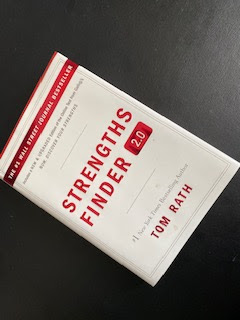
I took the test and my top strength is Responsibility. My initial reaction to this was frustration and disappointment. I was hoping for Teaching or Mentoring. Ironically, neither of these two appear as one of the 34 possible strengths listed in the book. After a couple of days of pondering this result, I can see that I do have a strong sense of responsibility. Apparently, I have to figure out how to leverage that to my advantage. I have to say, I don't have much appetite for that right now.
I mentioned this book and my test result to a friend on the bus our daily commute into work the other day. He is a production accountant in the oil industry. He laughed and told me about a career test he took just before finishing high school. It suggested that he should get into hotel management. At the time, he thought the result was a bit off the wall. Looking back now, he wonders if that test wasn't closer to the mark than he thought. It turns out his uncle went into hotel management, and ended up being quite (read very, very) successful.
I took a career test in high school and remember being (again) disappointed with the result. I was so put-off that I didn't even both to remember what the result was. I have always been bothered with personality/career tests in general. They seem so impersonal and yet could potentially carry so much weight. Did they work for you? I'd love to hear some experiences and/or stories...
Sept 22, 2013 - Update
After continuing to ponder my results from this test, particularly my 'top' strength, I can see how it has influenced my decisions over the years - the big life changing decisions. Here's an example - I was once invited to play as a drummer in a church band that I had dreamed about playing in. They played songs I wanted to play with the level of quality that I really appreciated. However, I felt I had to decline the invitation to play because I was already committed to helping a smaller, less developed church with their music ministry. The leader of that progressive church band who had given me the invite became internationally known over then few years. I've often wondered what would have happened had I taken advantage of that opportunity instead of declining it.
I am and continue to be interested in how these '5 strengths' impact and influence me. My top 5 strengths are: Responsibility, Futuristic, Intellection, Arranger, and Includer. The book talks about how to use them to your advantage. There are many times where I feel that while they are definitely at work in me and influencing my thoughts and decisions, they work against me. Sometimes, I just want a break from responsibility for a bit!
Subscribe to:
Posts (Atom)